Showing posts with label Our Pink Thoughts. Show all posts

Shooting for the Moon - One Production at a Time

When Andrie Nel first became involved with theatre in high school, she knew she had found her passion in life. She dove in head first, scoring a role in every play her high school offered. Once graduated, the job market was calling and Andrie did not continue in theatre until her mid to late twenties. This time, her love of theatre blossomed even more and she became very passionately involved with several drama groups. In one year, she was doing up to nine plays, sometimes rehearsing three at one time.

She knew when she left the stage to raise a family that many years later she would come back to it. “I had plateaued and I didn’t mind stopping at that point. I said I would return, but I would return in a way that encourages kids [to learn drama]. “I only discovered in high school that I loved this,” she says. What might have happened if I discovered it earlier?”

With a family in the works, Andrie pursued her MBA and opened a business consulting firm that worked with the high tech sector. Andrie and her husband, who she met in theatre, took turns playing the role of the stay-at-home parent. “I knew I could be successful at the job and I enjoyed it for many years, but I also realized the assumed goal of being a president was not what I wanted to do,” she says. “I was not going to go where I was programmed to go.”

Out in the country, where Andrie was born and raised, there was not a lot in the way of formal drama training. In schools, children were limited to sports as an after-school activity and there were not many businesses nearby offering alternatives. While she pulled back work-wise, she quickly became involved with the school council and the community. It was there Andrie realized that the arts were severely underrepresented.

As the mother of two children with learning disabilities, it became obvious to her that there was no place for her kids – and others like them – to shine.  Her notion of returning to the stage slowly turned into a reality, and in the capacity she had always dreamed. Andrie formed a drama club and put on several plays in the next year.  The program grew too large for the school and Andrie’s hunger to have a drama program for kids from all across their rural town made moving into the Old Metcalfe Town Hall a logical choice.

Just Kiddin’ Theatre was born December 2006, out of Andrie’s fervent passion for theatre and the drive to deliver a quality dramatic arts program to kids of Ottawa’s rural south.  It continues to thrive thanks to her dedication and the support of volunteers, parents and the children. Andrie does it all – runs the non-profit organization, writes, directs and produces the plays, and raises a family with three teenage daughters. “I have modeled to them that regular people can do this and nothing is out of reach for them.”

Andrie has always lived by the motto “Shoot for the moon. Even if you miss, you’ll land among the stars.” Andrie is living proof that those who pursue their dreams wholeheartedly will one day live them out. “It comes down to passion. If you’re passionate about it, listen to that passion and let it lead you there,” she says. “If you’re not passionate, then think twice, because then it is work.”


Keeping all of the balls in the air to run Just Kiddin’ may seem like grueling work. If you asked Andrie on any given day, she would agree, but with that comes many rewards. “It’s always the kids that keep me going – cliché but it is true. There are days when I am exhausted, but the enthusiasm and the innocence of the kids absorbing and doing their stuff energizes me,” she says. “It is self-sustainable because they bring as much energy back every time.”

Most days, Andrie feels she is living an ordinary life complete with its ups and downs but also feels like she has had a bit of an eccentric life. “I went against the grain. My husband and I traded traditional roles and I didn’t feel boxed in by mainstream thought,” she says. “If I only had the option to pass down one value to my kids it would be that. Just because other people do it doesn’t mean you have to. Don’t be afraid to take risks, challenge the norm and try new things. Nothing is a waste of time if you believe in it.”

Written by Daria Locke
Edited by Kristine Scarrow
Published by Catherine Brindley

Joanne Farley - "Never Turn Anyone Away"

With a $5,000 donation and a dream, West Island Citizen was born in 1976 with the idea that a community takes care of its disadvantaged residents with no other reward than the good feeling of a job well done.

Thirty-five years later, the philosophy hasn’t changed but the organization sure has.

Funding has ballooned from the initial $5,000 to more than $500,000 annually and the number of protégés has jumped from 15 matches in its first year to approximately 400 today.

Citizen Advocacy’s conception can be attributed to a Winnipeg conference founder Joanne Farley attended in 1976 where she was inspired by Dr. W. Wolfensberger and his “people helping people” philosophy.

As the parent of an autistic and intellectually challenged son, Joanne had already spent more than 20 years championing the causes of people with intellectual and physical challenges in the West Island of Montreal when she decided to open the first Citizen Advocacy office in Quebec. 

“She was strong, determined and nothing stood in the way of what she wanted,” said Mary Clare Tanguay, Joanne’s daughter and current Director of Citizen Advocacy.

When Paul was born in 1950 and later diagnosed with autism, a term unfamiliar at that time, it pushed her to spend the next four decades creating educational, recreational, and housing programs for the handicapped. 

In addition to helping establish the first special education program in Quebec with the Baldwin Cartier School Board, Joanne sat on the board of the West Island Association for the Intellectually Handicapped and helped raise funds to get the Gary Taylor Centre built.       

If that weren’t enough, she helped establish a summer camp for the intellectually handicapped at Camp  Kinkora and she was involved in the development of the  Lakeshore Vocational Project which provided jobs with local employers for the intellectually handicapped. 

In 1985 WICA launched a housing project called the Church Apartment Program designed to provide supervised housing for people experiencing mental health problems.  CAP provides shelter for 42 residents in the community as well as in two apartment complexes called Heron House and Farley House. 

The primary mandate is to recruit, screen, match and follow up volunteers with disadvantaged people in the community.  It could include the intellectually and physically challenged, people experiencing mental health problems, and seniors.

Mrs. Farley’s philanthropic efforts have not gone unnoticed.  She was awarded the Order of Canada in 2004, which was hand-delivered to her Pointe-Claire residence by then-Governor General Adrienne Clarkson.

“It was her philosophy to never turn anyone away,” said Mary Clare.

That philosophy has carried Citizen Advocacy into the year 2011 and counts almost 400 active matches, 350 volunteer advocates and almost 500 protégés.  

Written by Marla Newhook
Edited by Lucinda Atwood
Published by Catherine Brindley

What Inspires You?

Imagine a leader. In your head. Or draw it out on paper. Describe them. Is this person a man? Or is this person a woman?

For me, that person is a woman. A woman who is extremely knowledgeable in her field. One who leads by example, and one who makes a difference in people’s lives.  I would like to celebrate the success of one of my professors who has shown us what it means to be a leader, and what a good leader is capable of.

Marilyn Laiken, PhD, has accumulated numerous accomplishments throughout her career. She has been serving consulting clients since 1975, and is a Professor Emeritus at the University of Toronto’s Ontario Institute for Studies in Education (OISE). In fact, she was the Chair of the Department of Adult Education and Counselling Psychology at OISE, and is still the Director of the Certificate Programs in Adult Training and Development, and Leadership Coaching for the Workplace. Marilyn has published numerous journal papers and authored several books, including “The Anatomy of High Performing Teams: A Leader’s Handbook”.

Despite all her success and accomplishments, many of which are not listed here, she is an ordinary woman who is not so ordinary in her own ways. She showed all of us that women can be great leaders. I can say that of all the teachers I have had throughout the years, she has had the greatest impact on me.

I had the fortunate experience of being in one of her classes last year, and it was an extremely memorable experience. Each and every single one of us in her class learned a lot about ourselves and each other. With Marilyn’s help we learned how to work through problems together. We also learned how to make ourselves become a better leader.

Marilyn was so calm and so patient with everything and everyone. She would always make sure each of us was comfortable, right down to the tiniest detail, such as food preferences. She led by example the entire time and taught us the gracious way to handle problems and find solutions. “Seek first to understand, then to be understood.”

Every person’s picture of a leader is different. To me, the greatest quality of a leader is being able to inspire others. Inspiring is defined as “to prompt or instigate by influence, without avowal of responsibility”. And Marilyn does exactly that. She naturally fills her students with a feeling of trust and confidence.

I know this because I’m not the only one who thought so. As one of my classmates, Sharon, said, “Marilyn Laiken is an inspirational role model: she encouraged her students to be open, patient and respectful with each other, and she exhibited those very qualities in every class and in all correspondences. She is a teacher who practices what she preaches, someone who truly exemplifies what a good leader and role model should be.”

There are a lot of things Marilyn can be called: a great mother, a great Department Chair, and a great Director. The list goes on. But to me, and many of us, she is a great teacher, and most of all, a great leader.

Thank you, Marilyn, for making our classroom a peaceful and growth enhancing place.


Written by Queenie Cheung
Edited by Lucinda Atwood
Published by Catherine Brindley

Francesca Imbrogno: Small Acts with a Big Heart

“I have met amazing people, and feel blessed to have been able to share my passions while helping others”


Few women can say that they belong to a team called “The Sisterhood of the Pink Crusaders” – but Francesca Imbrogno can, proudly. In fact, she created it. The all-female team that Francesca formed six years ago for the Canadian Cancer Society’s Relay for Life is just one of myriad examples of her ceaseless benevolence.
A strong advocate for female leadership, Francesca has been an instrumental leader in student government at the University of Toronto for the duration of her undergraduate career. She has served on the St. Michael’s College Student Union and as a participant in numerous other endeavours. In her final year, she became the first female President of SMCSU in five years.
Throughout her time at U of T, Francesca successfully rallied students to raise thousands of dollars for notable causes such as Play for a Cause, ShareLife, the Canadian Cancer Society, Out of the Cold, and the Haiti Relief Fund.
As Social Events Co-ordinator, she organized a party that drew over 1,000 attendees and raised $6,000 for PlayPumps International, a non-profit organization that provides easy access to clean drinking water for millions across Africa.
In 2002, when Francesca’s father was diagnosed with colorectal cancer, she began proactively researching opportunities to get involved and raise awareness.
This led to the eventual formation of Cuts for Christmas, an annual event recognized by the Canadian Cancer Society.
Each December, Francesca—along with the many courageous men and women whom she persuades—chops off her long locks and donates them to make wigs for those who have lost their hair during cancer treatments.
The event, now in its third year, has raised over $3000 and donated over 25 participants’ hair to Pantene Pro-V Beautiful Lengths and Locks of Love. In gratitude, Francesca received an unbelievable outpouring of love and support from the U of T community, as well as the community at large.
Francesca is vivacious, inspiring, and consistently generous; she has a heart of gold (and a dance that can put Justin Timberlake to shame). In her 22 years, she has already become a role model for those around her and has done what often takes others a lifetime to achieve.
In her own words, “I have met amazing people, and feel blessed to have been able to share my passions while helping others”.
Her long list of achievements and accomplishments hardly compares to the long list of lives that she has changed along the way. A beautiful person inside and out, Francesca Imbrogno is impossible to define as anything but amazing – she is truly an example of an outstanding Canadian woman.

Written by Cristina Rizzuto
Edited by Lucinda Atwood
Published by Catherine Brindley


There's So Many Things That She's Going To Do...

Chelsea won't be the one to tell you she's an accomplished woman. "I just do what I have to do" she says to me over the phone while sitting on a curb in Toronto. Upon first speaking with Chelsea, one thing is clear; this woman is motivated, focused and ambitious. I'm quite sure that in five lifetimes one could not do all she has done.

At just sixteen years of age, Chelsea became the Chairperson of the Mayor’s Student Advisory Committee in Mississauga. The committee advocated for health, environmental, transportation, and political issues that affect youth. She spearheaded a program that reached out to schools in Mississauga, designating student liaisons who identified youth issues, and worked toward developing and implementing solutions.

When she became a student at the University of Waterloo, she decided to continue her outreach work by founding and leading a student mayoral advisory council in her new home, Waterloo. Not only did she provide a voice for students at the University of Waterloo, but she also organized events and committees with the goal of bonding post-secondary students within the Kitchener and Waterloo area.

As part of her master’s program, through her work with the Centre of Advancement for Female Entrepreneurship, she was a mentor to a student from Al Ain University in Abu, Dhabi, United Arab Emirates. She also contributed to the curriculum for a business certification course to empower women in Abu Dhabi.

Since her university days, Chelsea has worked in marketing, film production, civic and youth engagement, business management and event planning. She's worked with youth in the Jane-Finch community of Toronto through the Youth Unlimited Blueprints program, which empowers youth through life skill and entrepreneurial training and mentorship.

Chelsea’s extensive work demonstrates her biggest passions: building community and allowing that community to have a voice. She explains, "I believe I have been tasked with the mission to help individuals and communities develop their gifts and voice as well as establish forums in which they can be heard.”

Her work with youth is extremely important to her because she believes that children are more in tune with the gifts they are born with. It is important for parents and teachers to recognize and foster these gifts at a young age, through mentorship and support. She is in tune with her own gifts because she has been blessed with great mentors in her community and family, in Mississauga as well as at the University of Waterloo.

The future is wide open for Chelsea. She looks forward to continuing her current work which includes being a Talent Wrangler on CBC's hit show Battle of the Blades, and developing The Adva Effect, a company that produces informative and inspirational documentaries. The Adva Effect creates media content that educates, engages and empowers audiences. They are launching a music video in November that was produced for a rap artist, Freddy Will from Sierra Leone. As if that didn’t keep her busy enough, Chelsea will also be speaking at TED X UW in November at the University of Waterloo.

Although I wasn't fortunate enough to meet Chelsea face to face, I enjoyed a lovely conversation in which we discussed our goals and challenges. I was inspired by her eagerness to learn from and reach out to others. She is genuinely interested in the passions and journeys of others.

Written by Christine Seguin
Edited by Lucinda Atwood
Published by Catherine Brindley

Guest Celebrity Writer - Stephanie Hooker


Hannah Taylor - 15 Year Old Hero

Winnipeg native Hannah Taylor, 15, is an extraordinary young hero who proves that age doesn’t matter when the heart is set on making change. After seeing a man eating from a dumpster when she was five, Hannah was moved to action by her mother’s inspiring words: “If you do something to change the problem, your heart won’t be so sad.” In no short order, a young social rights activist was born and she has been “doing” ever since. She has received numerous awards, accolades and recognition for her hard work and dedication to raising awareness about poverty across Canada and the United States.

Hannah founded The Ladybug Foundation – a charitable organization that shines light on homelessness – when she was just eight. Since its humble beginnings collecting loose change in painted ladybug jars, The Ladybug Foundation has raised over $2 million dollars for organizations across Canada.

In 2008, Hannah was invited to launch National Red Scarf Day on January 24 to increase awareness and funds for the homeless; it’s now in its 4th year. History was made in Ottawa on the day when all the Senate and Members of Parliament gave a standing ovation in support of the same cause on the same day. Together Ottawa and Canada showed their support by wearing Ladybug Foundation Red Scarves on January 31st, National Red Scarf Day

She is also part of an international program called the World’s Children Prize for the Rights of the Child. Nelson Mandela is the patron. Hannah sits on a jury that recognizes international candidates each year for their child advocacy work.

If you ask her what makes her so special, don’t be surprised by an awkward pause and a change of topic. “I am so lucky to have such powerful women in my family – amazing, amazing strong women.” She is adamant that they have as much to do with her can-do attitude as she does. More important, she says “they taught me not to be scared. They believe in me and that makes anything possible.”

Hannah proves that we have much to learn from our young people. In fact, it is precisely this infectious combination of innocence and resolve that both captivates and mobilizes people at the same time. Her vision that “no one should have to eat out of a garbage can” is shockingly simple. And in this simplicity there is pure beauty.

Recently Hannah, along with The Ladybug Foundation, took another step in educating the public when they started a sister charity called MakeChange™, The Ladybug Foundation Education Program. Hannah admits she cannot speak at every school, so MakeChange™ bridges the gap by bringing ideas to the classroom. Developed by a team of experienced teachers, the program has one purpose: to empower young people to get involved and make change in their own community.

“It doesn’t have to be homelessness.” she adds. “It could be the environment, or human rights; whatever they’re interested in. You should never dismiss what children say when they’re passionate. Children already feel small, but they can make change in their own way and when that light goes off in their head, it’s amazing what they can do.” She would know. Hannah estimates the curriculum based programming is already in around 7000 classrooms across the country and is currently being translated into French.

Although, she seems unnaturally fearless in the presence of diplomats, politicians and rock star activists, she does worry about whether the homeless will approve of her work. “I just want to make sure I represent them well.” As for actually conducting public speaking engagements, attending meetings with VIPs, or taking on enormous responsibilities and meeting the tall expectations people may have of her – no problem. “I don’t feel pressure because it’s not about me going far. It’s about them.”

If she retired now, Hannah could rest well on her laurels. There are many: prestigious awards, over 200 speaking engagements including a nod as the youngest speaker ever at the Empire Club in Toronto, Ontario and author of a best-selling children’s book “Ruby’s Hope,” (2006). She has an ongoing mentorship with President of the CanWest Global Foundation, Gail Asper, a renowned community activist is her own right, and - well, you get the picture – an impressive portfolio for one so young. But frankly, I don’t think there is much resting for Hannah, on laurels or anything else.

She isn’t sure what her future holds. “I will always dedicate time to the homeless and other causes,” she says. But in the same breath she admits she has her eyes on other targets. “National Geographic… writing… photography. Who knows? I’m a normal teenager”, she says. “I have a great group of friends, three dogs, a cat and horses. I do my best at school and worry about normal teenage things.”

Sure, most teenagers can’t claim Gail Asper as their mentor, or that Nelson Mandela invited them to his house for a visit. And of course, most teenagers haven’t authored and published a children’s book, or typically speak in front of groups of up to 200 two or three times a month. But you see, that’s the real inspiration of Hannah Taylor – she thinks all of us can do what she does. And in her reflection, we feel compelled to shine a little brighter.

Written by Stephanie Hooker
Edited by Lucinda Atwood
Published by Catherine Brindley


Click here to help support The Ladybug Foundation

Perseverance Changed the Face of Canada

The ability to bring forth change is neither out of one’s control nor out of one’s reach. It is not limited to virtue or vice, to socioeconomic status, to social reputability, to money, or to any other seemingly valued attainment. It is unfortunate that society regards the above falsities as truth, forgetting that those who do not particularly possess these qualities are the ones who have spearheaded many of the most significant milestones in our Canadian history.
           
 Imagine being part of an existence that regarded you as second-grade to the opposite gender. One that did not care for your voices, opinions, concerns or your fears so that with every attempt you made at expressing discontent, you were ridiculed or ignored. Imagine being part of an existence that went so far as to fail to acknowledge you as a person unless you were male so that at the moment of your birth, your position in society was decided.

Whether this scenario is feasible for you or not, prior to 1929, this was the unfortunate reality for all women in Canada. Naturally, there was a shared resentment among all those affected throughout the many years that this was the lamentable truth, but on March 14th of 1868, a girl was born who would grow up to change my life, your life, and the face of Canada forever.
           
Born to Isaac Ferguson and Emily Gowan and named after her mother, Emily Gowan Ferguson lived a life much like yours or mine and just like you or I, she was taken aback when her eyes were opened to the harsh reality that so many women succumbed to.  Upon this realization, she began her efforts to make a positive impact on the lives of women and children and those affected by poverty and drugs. Over her lifetime, Emily’s contributions took the form of books, speeches, and other methods of spreading awareness of her causes; she was also the first woman magistrate in the entire British Empire.

Despite her accomplishments and contributions to society, she remained second-grade due to the simple fact that she was a woman. As a result, Emily, along with four other Canadian women, fought The Persons Case for twelve long years in attempts at achieving status for women in Canada, ignoring the ridicule and lack of optimism of others only to have the Supreme Court rule against them in their case. Led by Emily, these five brave women full of perseverance carried their case to Privy Council in Britain and on October 18th of 1929, women officially became recognized as persons on the British North America Act.
           
This inspiring woman, born as Emily Gowan Ferguson, is Emily Murphy and it is her efforts and drive that made this milestone possible. It is her perseverance that changed the face of Canada so far as to make it impossible for any woman today to even comprehend the injustices that were occurring prior to the passing of The Persons Case. It is her courage that allowed her to keep trying when her first attempt was unsuccessful and finally, it is her spirit that began this whirlwind of change that granted a voice for the women of her time and all women to follow.
           
Emily Murphy did not possess power, riches, or connections to assist her in her battles. It was not privilege or advantage that aided her in her achievements and although these things may help, they are completely irrelevant to success. What Emily Murphy did have, however, is ambition and this is all that is required to spark the flame that can ignite clarity through darkness. All of us have ambition. All of us have the ability to make a change. Think of something in your life that you wish could be better and do something to make it better. Today is brighter than yesterday but it is up to us to make tomorrow brighter than today.

 “I believe that never was a country better adapted to produce a great race of women than this Canada of ours, nor a race of women better adapted to make a great country”
- Emily Murphy

Written by Nadine Elmasri 
Edited by Kristine Scarrow 
Published by Cathrine Brindley

Novelist and Illustrator Storma Sire: A Creative Hero to her Students

When I first took a class with children’s author and illustrator Storma Sire, I was struck by her energy and enthusiasm.  She grins as she encourages her students to have fun with imagination-stretching writing exercises, and often emits a mischievous chortle at the results.  As a teacher she has the rare gift of finding and nurturing the unique talents of each student.  

A theme she emphasizes in her classes is creativity as a spiritual process, with exercises drawing on myths, fairy tales, and Jungian psychology.  She donates her time to run a free writers’ group as well as teaching several classes.  The atmosphere in her workshops is a mix of reverence (for the creative process) and irreverence (for conventional writing rules).  

I asked Storma how her views on creativity evolved.

“I was sickly as a kid, so I spent a lot of time alone reading and occasionally writing or drawing. I was a ferocious reader as a kid. I kept a journal as well that I would write in. It wasn't until I read a wonderful book called The Artist’s Way by Julia Cameron that I really began taking my writing more seriously. I always loved the work of Joseph Campbell and Carl Jung and their intricate ability to weave myth into personal life. Eventually as I became a more dedicated writer, I became interested in art as well. The two go hand in hand.”

Storma’s novel Lessons in Magic (which she also illustrated) tells the story of two ten-year-olds, Simon and June, who are on a desperate search to learn magic to save their hometown of Misty Mayfair, a town covered with fog for four months of the year.  During fog time, all those with magical abilities come out to play - wizards, witches, goblins and ghosts included. Simon and June must master the magical arts if they wish to save their home from an evil wizard bent on revenge. 

While trying to publish the book, Storma experienced some magic of her own.

“I was editing my book and was having a tough time with it. I was doing my laundry in the laundry room and a person that I'd known only a little bit at the time was there as well. We got talking and he told me he was an editor. He offered to have a look at it, then one thing led to another and I got published.”

Just 35 years old, Storma had worked in the financial industry as a stockbroker, and then as an actress and filmmaker before turning to writing and art.

I read somewhere that the things you loved to do when you were 10 years old are the things that you'll love to do throughout your life. For me this is very true. When I was 10 I loved art, writing and painting, then something happened when I got older and I somehow forgot. When I reached my late 20s and early 30s I realized what I loved again. I had many different types of careers and jobs by then, but in the end I had to do what I loved if I were to be happy.”

She is also interested in psychology and its link to creativity.  She volunteered for years as a crisis line and suicide prevention counsellor, and is pursuing studies in art therapy.  She believes psychology and art share spiritual roots.

I became interested in psychology after studying Joseph Campbell and Carl Jung. I loved the idea that "psyche" meant soul and that to study psychology was to study the soul. I think psychiatrists, psychologist, counsellors and therapists tend to forget this sacred beginning. I wish to specialize in art therapy as I'm comfortable with symbols and symbolic language. Profound and rapid healing can be found there. Not everyone can articulate their feelings, so the arts can be an excellent way to bridge that gap.”

She has recently finished her second book.  I asked if she has a title yet.

I've not figured that out yet. Titles always take some time for me. The second book is about two eleven-year-olds and their continued adventure and misadventure with magic. It is the sequel to the first book.”

As an artist, writer, teacher and future therapist, Storma continues to inspire those around her to draw on spiritual sources for their creative pursuits... and to have fun!

Written by Lauryn Savage
Published by Catherine Brindley


Lessons in Magic is available through Aydy press at their website: http://members.shaw.ca/aydy/lessonsinmagic.htm

Mary Ann Shadd Cary (1823-1893)

Women are often identified as teachers. We teach through child rearing and mothering. We teach through our community involvement. We teach professionally. In our many roles, women hold a unique place as teachers: to each other, to our communities, to our children and to ourselves.  An early example of an exceptional woman teacher in Canada’s past is Mary Ann Shadd Cary.

 
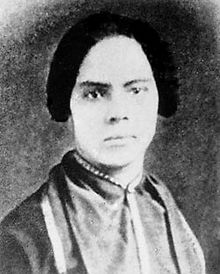
 The only known photo of Mary Ann Shadd Cary (1823-1839)
 Mary Ann grew up in the Northern United States and arrived in Windsor, Ontario in 1853. Although she was never a slave herself, she was committed to abolishing slavery. Mary Ann, along with her family, was part of the mass migration of Blacks, both fugitive and free, to Ontario (then Canada West) following the American Fugitive Slave Act in 1850, which resulted in heightened racial tension and increased violence against Blacks across the United States. Mary Ann brought with her to Canada a commitment to both teaching and activism.
           
Mary Ann Shadd Cary is probably best known in Canadian history as the first woman to establish and be editor of a newspaper in Canada. She founded The Provincial Freeman in 1853, a newspaper dedicated to supporting the Black community in both the US and Canada. Through The Provincial Freeman, Mary Ann created for herself a public voice through which she expressed her greatest concerns. She was a journalist, an activist and a teacher to the many Blacks and whites who read her newspaper.
           
Mary Ann’s political activism and involvement also gave her an opportunity to provide public lectures. This was still very uncommon for women at this time, and even for a generally well-liked public figure like Mary Ann, there was often great opposition to her speaking publicly. Nonetheless, Mary Ann was dedicated to her work and spent a great deal of her time travelling and speaking on various issues affecting the black community. She was a powerful, dynamic speaker who educated and inspired many to get involved in the abolition movement.
           
The Provincial Freeman, March 24, 1853
Not only did Mary Ann step beyond what was considered ‘appropriate’ work for a woman through her newspaper and public speaking, but she was a teacher in the more traditional sense as well.  Mary Ann was committed to providing education to Blacks her whole life. Like many, she saw literacy and education as key factors in achieving freedom and autonomy. Upon arriving in Windsor, Mary Ann established a school, open to all in the community. Her duties as a teacher included teaching the lessons, recruiting students, maintaining the building, and fundraising. Although the school ultimately closed due to lack of financial support, there is no doubt that Mary Ann’s work as teacher touched many who passed through her school.
           
In addition to her day-school, Mary Ann also ran a Sunday school class, another teaching role traditionally held by women. Although religion and spirituality have been noted as being especially important to Black migrants during this period, Mary Ann was often critical of Black churches as she claimed that they too often preached passivity and submission, rather than activism. Given her feelings on these issues and her personal commitment to activism, it is likely that Mary Ann used her Sunday school class to inspire and educate in unconventional ways as well.
           
Like many women of her time, Mary Ann Shadd Cary was a school teacher, and had an incredible commitment to local charity, her family and children. While she is certainly an inspiration for being a teacher in these ways, it is the ways in which she pushed past traditional expectations that remain exceptional. Her dedication to equality, justice and freedom led her to be a teacher of many, through her newspapers, writing and public lectures.
           
When I reflect on the life of Mary Ann Shadd Cary, I am struck by her strength. As limited as she was by both her race and her gender, she was not discouraged by the discrimination she faced. She used her own experiences and her own struggles to teach others.  Like many other women across generations who have migrated to Canada, Mary Ann contributed a great deal to her community. Her influence cannot be measured in any simple sense. Yet even today, over a hundred years after her death, she continues to be a teacher who is encouraging, motivating and inspiring.

Written by Patricia Kmiec 
Published by Catherine Brindley